Standardization of the assisted reproduction technique embryo transfer in mice (Mus musculus) at CENPALAB
Article Sidebar
Main Article Content
Abstract
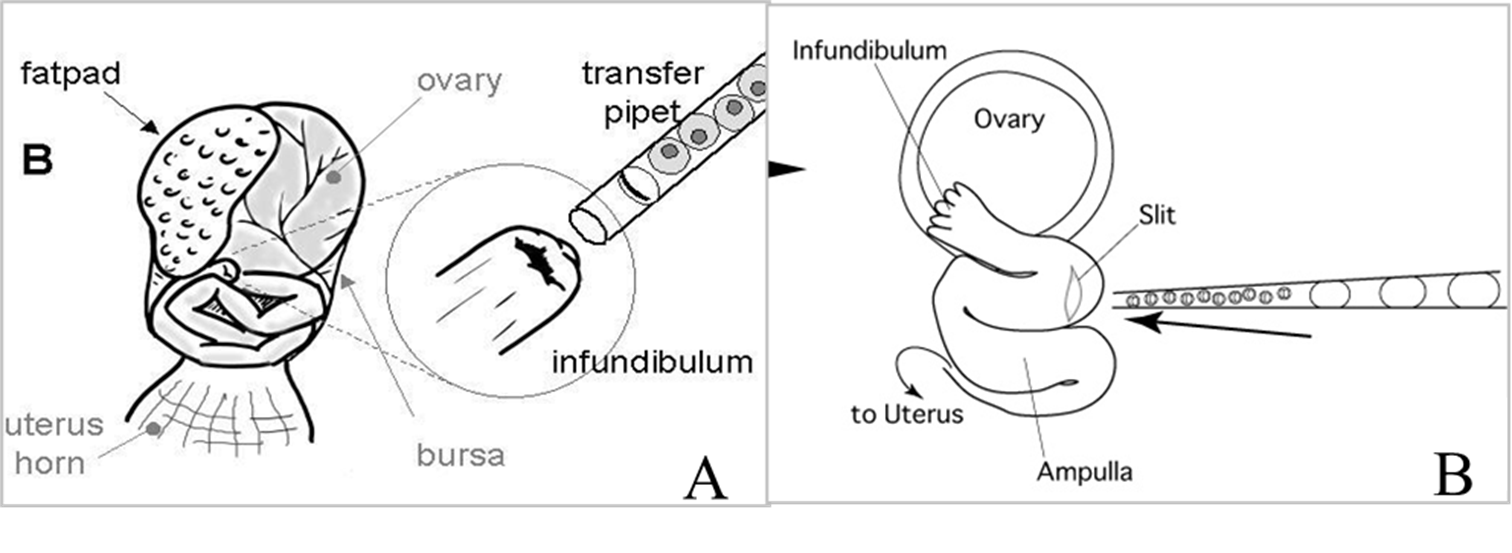
The present study aimed to standardize embryo transfer (ET) protocols under CENPALAB's working conditions. Surgical technique for two-cell embryo transfer into the oviduct, the assessed recipient strain effects (B6D2F1, OF1, and NMRI mice) and recipient age impact were evaluated using gestation percentage and live birth count as success parameters. These results demonstrate that embryo transfer to the oviduct can be successfully performed using either the Whittingham (1968) or Nakagata (1992) surgical techniques. Furthermore, recipient females from B6D2F1, OF1, or NMRI strains showed equivalent efficacy when used at their optimal reproductive age (11-14 weeks). It can be confirmed the embryo transfer protocol was successfully standardized at CENPALAB. This milestone is particularly valuable because it: (i) allows integration into routine mice production, (ii) supports maintenance of reproduction-compromised strains, and (iii) establishes the technical basis for future applications including rederivation processes, in vitro fertilization, and embryo cryopreservation techniques.
Article Details

This work is licensed under a Creative Commons Attribution-NonCommercial 4.0 International License.
National Center for Animal and Plant Health (CENSA)References
Citra Nur M, Tyagita H, Ronny L. Kajian Pustaka. Use of mice as experimental animals in laboratories that refer to the principles of animal welfare: a literature review. Indonesia MedicusVeterinus. 2021; 10 (1): 134-145.
Suckow M. A., Hashway S, Pritchett-Corning, K. R. The laboratory mouse 3erd ed, CRC press; 2023.
Santos Lamas SC. Mouse embryo rederivation and other assisted reproductive techniques and their impact on experimental results. Doctoral dissertation. Porto: Universidade do Porto. 2021
Nakagata N. Embryo transfer through the wall of the fallopian tube in mice. Exp Anim. 1992;41(3):387-388.
Lamas S, Franquinho F, Morgado M, Mesquita JR, Gärtner F, Amorim I. C57BL/6J and B6129F1 embryo transfer: unilateral and bilateral transfer, embryo number and recipient female background control for the optimization of embryo survival and litter size. Animals. 2020;10(8):1424.
Whittingham DG. Fertilization of mouse eggs in vitro. Nature. 1968;220(5167):592-593.
Maurya VK, DeMayo FJ, Lydon JP. Illuminating the black box of progesterone dependent embryo implantation using engineered mice. Front. Cell. Dev. Biol. 2021;9:640907. doi: 10.3389/fcell.2021.640907.
Auer KE, Kolbe T, Laschalt C, Rülicke T. Comparison of unilateral and bilateral embryo transfer in mice. Laboratory animals. 2023;57(4), 424-431.
Petters RM, Johnson BH, Mercer WE. Production of transgenic mice following deoxyribonucleic acid microinjection and embryo freezing. Theriogenology. 1987;27(3):507-515.
Garcia Y, Sanchez MA. Introducción en el manejo y obtención de embriones de ratón para su modificación genética. FarmaJournal. 2016;1(2):133-142.
Talbert GB, Krohn PL. Effect of maternal age on viability of ova and uterine support of pregnancy in mice. Reproduction. 1966;11(3):399-406.
Hopper RM. Boovine Reproduction. 2da ed. JhonWiley&SonsInc; 2021.
Rose C, Schwegler H, Hanke J, Yilmazer-Hanke DM. Pregnancy rates, prenatal and postnatal survival of offspring, and litter sizes after reciprocal embryo transfer in DBA/2JHd, C3H/HeNCrl and NMRI mice. Theriogenology. 2012;77(9):1883-1893.
Eaton ON. Heterosis in the performance of mice. Genetics. 1953;38(6):609.
Kim H, Bang J, Baek SH, Park, JH. Eliminating murine norovirus, Helicobacter hepaticus, and intestinal protozoa by embryo transfer for an entire mouse barrier facility. Experimental animals 2022;71(1), 28-35.
Qianqian WANG, Sijue TAO, Zhen WEI, Huihui JIN, Ping LIU, Lie WANG. A Case Study of Using Assisted Reproductive Technology to Rescue Genetically Modified Mice with Reproductive Disorder Phenotypes. Laboratory Animal and Comparative Medicine. 2025;45(1), 79.
Hart-Johnson S, Mankelow K. Archiving genetically altered animals: a review of cryopreservation and recovery methods for genome edited animals. Laboratory Animals. 2022;56(1), 26-34.
Takeo T, Nakao S, Nakagawa Y, Sztein JM, Nakagata N. Cryopreservation of mouse resources. Laboratory Animal Research.2020;36: 1-6.