Heavy metal levels in milk and cheese marketed in the city of Cajamarca, Peru
Article Sidebar
Main Article Content
Abstract
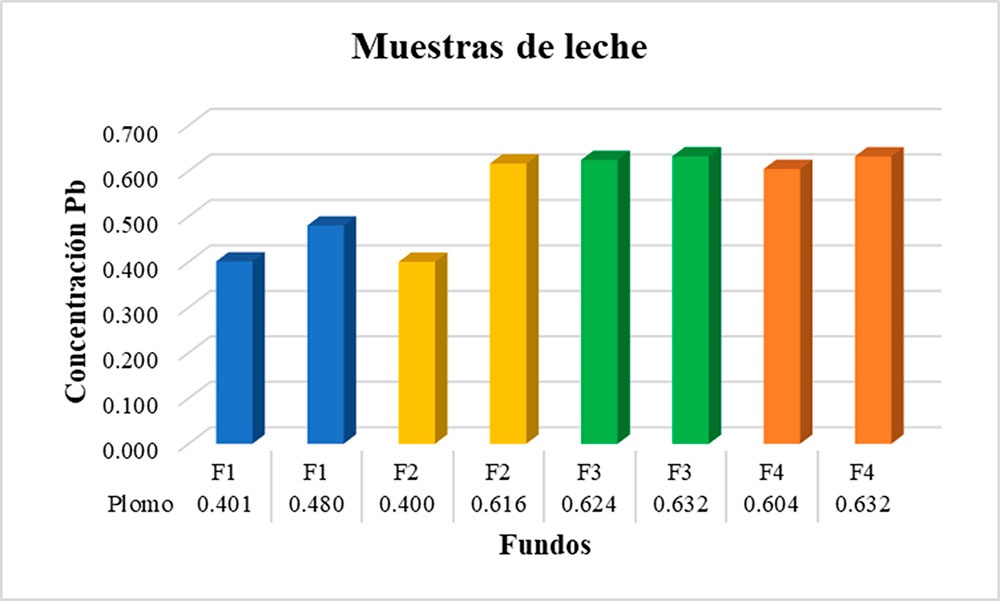
Heavy metals are highly harmful environmental pollutants due to their toxicity, persistence in the atmosphere and their ability to accumulate in the human body and other biological organisms. Environmental negligence and improper husbandry of farm animals can allow their products to contain elevated levels of heavy metals, posing a risk to public and environmental health. This study aimed to determine the levels of cadmium and lead in milk samples from cows fed forage irrigated with sewage water, as well as in cheeses marketed in the city of Cajamarca, Peru. Eight milk and 12 cheese samples were taken and analyzed using Graphite Furnace Atomic Absorption Spectrophotometry (GFAAS). In the milk samples, the lead level ranged from 0.400 to 0.632 mg/L and cadmium from <0.001 to 0.008 mg/L (p=0.000). Meanwhile, all cheese samples had levels below 0.02 mg/kg for lead and less than 0.01 mg/kg for cadmium. The results suggest that the presence of lead in the milk is likely related to the use of forage irrigated with wastewater. Furthermore, this finding underscores the need for continuous monitoring and management of heavy metal content in food, especially as agricultural and dairy production practices evolve.
Article Details

This work is licensed under a Creative Commons Attribution-NonCommercial 4.0 International License.
National Center for Animal and Plant Health (CENSA)References
Silva ARA da, Santelli RE, Braz BF, Silva MMN, Melo L, Lemes AC, et al. A Comparative Study of Dairy and Non-Dairy Milk Types: Development and Characterization of Customized Plant-Based Milk Options. Foods 2024;13. https://doi.org/10.3390/foods13142169.
Irving Pease EK, Refoyo Martínez A, Barrie W, Ingason A, Pearson A, Fischer A, et al. The selection landscape and genetic legacy of ancient Eurasians. Nature 2024;625:312-20. https://doi.org/10.1038/s41586-023-06705-1.
Mezzetti M, Passamonti MM, Dall’Asta M, Bertoni G, Trevisi E, Ajmone Marsan P. Emerging Parameters Justifying a Revised Quality Concept for Cow Milk. Foods 2024;13:1650. https://doi.org/10.3390/foods13111650.
Cimmino F, Catapano A, Petrella L, Villano I, Tudisco R, Cavaliere G. Role of Milk Micronutrients in Human Health. Front Biosci 2023;28:41. https://doi.org/10.31083/j.fbl2802041.
de Andrade VL, Ribeiro I, dos Santos APM, Aschner M, Mateus ML. Carcinogenic Risk from Lead and Cadmium Contaminating Cow Milk and Soya Beverage Brands Available in the Portuguese Market. J Xenobiotics 2024;14:798-811. https://doi.org/10.3390/jox14020045.
Yan M, Niu C, Li X, Wang F, Jiang S, Li K, et al. Heavy metal levels in milk and dairy products and health risk assessment: A systematic review of studies in China. Sci Total Environ 2022;851:158161. https://doi.org/10.1016/j.scitotenv.2022.158161.
IARC Working Group on the Evaluation of Carcinogenic Risks to Humans. Arsenic, Metals, Fibres and Dusts. Lyon, France: 2012.
Rice KM, Walker EM, Wu M, Gillette C, Blough ER. Environmental Mercury and Its Toxic Effects. J Prev Med Public Heal 2014;47:74-83. https://doi.org/10.3961/jpmph.2014.47.2.74.
Numa Pompilio C-G, Francisco C-S, Marco Tulio F de M-T, Sergio Samuel S-M, Fernanda Elisa G-J. Heavy metals in blood, milk and cow’s urine reared in irrigated areas with wastewater. Heliyon 2021;7:e06693. https://doi.org/10.1016/j.heliyon.2021.e06693.
Castro Bedriñana J, Chirinos Peinado D, Ríos Ríos E, Machuca Campuzano M, Gómez Ventura E. Dietary risk of milk contaminated with lead and cadmium in areas near mining-metallurgical industries in the Central Andes of Peru. Ecotoxicol Environ Saf 2021;220:112382. https://doi.org/10.1016/j.ecoenv.2021.112382.
González E, Ahumada R, Medina V, Neira J, González U. Espectrofotometría de absorción atómica con tubo en la llama: aplicación en la determinación total de cadmio, plomo y zinc en aguas frescas, agua de mar y sedimentos marinos. Quim Nova 2004;27:873-7. https://doi.org/10.1590/S0100-40422004000600006.
Comisión del Codex Alimentarius. Norma General para los Contaminantes y las Toxinas presentes en los Alimentos y Piensos (CODEX STAN 193-1995). Roma: 1995.
Portal Legislativ. Limite maxime de arsen şi metale grele în alimente | Normă (Límites máximos de arsénico y metales pesados en los alimentos | Norma). Rumania: 1998.
Abel SC. Remoción de plomo de las aguas del río San Lucas utilizando biofiltro de arcilla y hojas de nogal - Cajamarca”. Universidad San Pedro, 2019.
Gutiérrez Arce WJ. Metales pesados en Lolium multiflorum y Trifolium repens cultivados en agua residual in vitro. Universidad Nacional de Cajamarca, 2017.
Choquepata DP. Determinación de metales pesados en leche y pelo de vacas de la cuenca del Rio Ilallimayo Melgar - Puno. Universidad Nacional del Altiplano, 2018.
Zhou X, Zheng N, Su C, Wang J, Soyeurt H. Relationships between Pb, As, Cr, and Cd in individual cows’ milk and milk composition and heavy metal contents in water, silage, and soil. Environ Pollut 2019;255:113322. https://doi.org/10.1016/j.envpol.2019.113322.
Shailaja M, Reddy YS, Kalakumar BDP, Brinda SA, Manohar G, Kumar BD. Lead and trace element levels in milk and blood of buffaloes (Bubalus bubalis) from Hyderabad, India. Bull Environ Contam Toxicol 2014;92:698-702. https://doi.org/10.1007/s00128-014-1258-x.
Batool F, Iqbal S, Tariq MI, Akbar J, Noreen S, Danish M, et al. MILK: Carrier of heavy metals from crops through ruminant body to human beings. J Chem Soc Pakistan 2016;38:39-42.
Ibrahim A, Awad S, Elsenduony M. Assessment of some chemical residues in Egyptian raw milk and traditional cheese. Open Vet J 2024;14:640. https://doi.org/10.5455/OVJ.2024.v14.i2.4.
Penaud S, Fernandez A, Boudebbouze S, Ehrlich SD, Maguin E, van de Guchte M. Induction of Heavy-Metal-Transporting CPX-Type ATPases during Acid Adaptation in Lactobacillus bulgaricus. Appl Environ Microbiol 2006;72:7445-54. https://doi.org/10.1128/AEM.01109-06.