Detection of begomovirus in tomato (Solanum lycopersicum L.) using magnetic nanoparticles
Article Sidebar
Main Article Content
Abstract
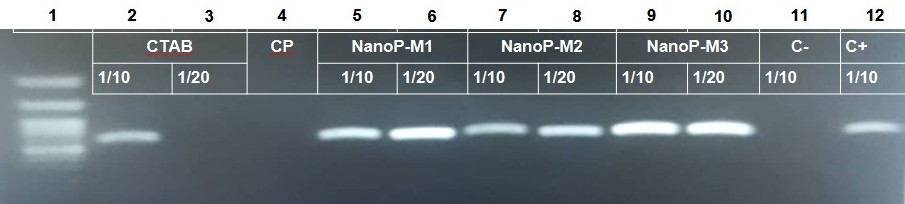
The objective of this study was to use the CEA-NANO+ RNA 3.0 magnetic nanoparticle kit for to extract nucleic acids from tomato (Solanum lycopersicum L.) leaf material with yellowing, curling, and dwarfing, symptoms similar to begomoviruse infections. Nucleic acid extractions were carried out using a previously established laboratory method and a magnetic nanoparticles-based method. After nucleic acid purification, viral DNA was detected by PCR with generic begomovirus primers. The results of both methods were compared, and it was achieved an adequate sensitivity and analytical specificity for the amplification of DNA purified with magnetic particles. The feasibility of using the CEA-NANO+ RNA 3.0 kit for detection of begomoviruses was demonstrated.
Article Details

This work is licensed under a Creative Commons Attribution-NonCommercial 4.0 International License.
Aquellos autores/as que tengan publicaciones con esta revista, aceptan los términos siguientes:
- Los autores/as conservarán sus derechos de autor y garantizarán a la revista el derecho de primera publicación de su obra, el cual estará simultáneamente sujeto a la Licencia Creative Commons Attribution-NonCommercial 4.0 International (CC BY-NC 4.0) que permite a terceros compartir la obra, siempre que se indique su autor y la primera publicación en esta revista. Bajo esta licencia el autor será libre de:
- Compartir — copiar y redistribuir el material en cualquier medio o formato
- Adaptar — remezclar, transformar y crear a partir del material
- El licenciador no puede revocar estas libertades mientras cumpla con los términos de la licencia
Bajo las siguientes condiciones:
- Reconocimiento — Debe reconocer adecuadamente la autoría, proporcionar un enlace a la licencia e indicar si se han realizado cambios. Puede hacerlo de cualquier manera razonable, pero no de una manera que sugiera que tiene el apoyo del licenciador o lo recibe por el uso que hace.
- NoComercial — No puede utilizar el material para una finalidad comercial.
- No hay restricciones adicionales — No puede aplicar términos legales o medidas tecnológicas que legalmente restrinjan realizar aquello que la licencia permite.
- Los autores/as podrán adoptar otros acuerdos de licencia no exclusiva de distribución de la versión de la obra publicada (p. ej.: depositarla en un archivo telemático institucional o publicarla en un volumen monográfico) siempre que se indique la publicación inicial en esta revista.
- Se permite y recomienda a los autores/as difundir su obra a través de Internet (p. ej.: en archivos telemáticos institucionales o en su página web) antes y durante el proceso de envío, lo cual puede producir intercambios interesantes y aumentar las citas de la obra publicada. (Véase El efecto del acceso abierto).
References
Barboza N, Martínez Zubiaur Y. Begomoviruses in crops with economic interest for North and Central América. En: RK Gaur, Pradeep Sharma, Henery Czosnek (Eds). Geminivirus: Detection, Diagnosis and Management. Academic Press, ISBN 9780323905879; 2022. p.125-137.
Elmer W, White JC. The future of Nanotechnology in Plant Pathology. Annual Review of Phytopathology. 2018 ; 56:1, 111-133.
Marwal A, Gaur RK. Nanophytovirology: An Emerging Field for Disease Management. En: Snježana Topolovec-Pintarić (Ed). Plant Diseases-Current Threats and Management Trends. 2019. Disponible en: http://dx.doi.org/10.5772/intechopen.86653 p 220.
Verma N, Shukla M, Kulkani R, Pandya A. Emerging Extraction and Diagnostic Tools for Detection of Plant Pathogens: Recent Trends, Challenges, and Future Scope. ACS Agricultural Science & Technology. 2022; 2(3). DOI:10.1021/acsagscitech.2c00150.
Shivashakarappa K, Reddy V, Tupakula VK, Farnian A, Vuppula A, Gunnaiah R. Nanotechnology for the detection of plant pathogens, Plant Nano Biology. 2022; 2: 100018, ISSN 2773-1111.
Paul R, Ostermann E, Wei Q. Advances in point-of-care nucleic acid extraction technologies for rapid diagnosis of human and plant diseases. Biosensors and Bioelectronic. 2020; 169: 112592. ISSN 0956-5663, https://doi.org/10.1016/j.bios.2020.112592
OMNI International Blog. Accelerating Nucleic acid extraction in agriculture. 2024. Disponible en: www.blog.omni-inc.com/tag/nucleic-acid-extraction.
Chen Y, Liu Y, Shi Y, Ping J, Chen H. Magnetic particles for integrated nucleic acid purification, amplification and detection without pipetting. Trends in Analytical Chemistry 127. 2020; 115912.
Singh R, Kuddus M, Kumar PS, Choden D. Nanotechnology for Nanophytopathogens: From Detection to the Management of Plant Viruses. BioMed Research International. 2022, Article ID 8688584, 12 pages . Disponible en: https://doi.org/10.1155/2022/8688584
CEA-NANO+ RNA 3.0. Sistema de extracción magnética de ARN a partir de muestras biológicas. Instrucciones para el uso. REV.04-01/2023. Disponible en: . https://www.cea.cu/wp-content/uploads/2024/07/Instructivo-Ed.04-01-2023-1.pdf .
Centro para el Control Estatal de Medicamentos, Equipos y Dispositivos Médicos (CECMED). Ámbito Regulador. RESOLUCIÓN No. 43/2024. Disponible en: https://www.cecmed.cu/vigilancia/equipos-medicos/alertas/comunicacion-fabricante-012022-instrucciones-uso-ipu. Consultado Diciembre 2024.
Doyle JJ, Doyle JL . A rapid DNA isolation procedure for small quantities of fresh leaf tissue. Phytochem Bull. 1987. 19, 11–15.
Wyatt SD, Brown J. Detection of Subgroup III Geminivirus Isolate in leaf extract by Degenerate Primers and Polymerase Chain Reaction. Phytopathology. 1996; 86, p 1288-1293.
EPPO. PM 7/152 (1) Begomoviruses, Standard on Diagnostics. EPPO Bulletin. 2022; 52:643–664. Disponible en: https://onlinelibrary.wiley.com/doi/10.1111/epp.12887.
Roumagnac P, Ascencio-Ibanez, J, Lette JM et al. Rename 520 species (Geplafuvirales: Geminiviridae). International Committee on Taxonomy of Viruses. 2025. Disponible en: https://ictv.global/taxonomy/taxondetails?taxnode_id=202403484&taxon_name=Begomovirus%20coheni#release_35
Berensmeier S. Magnetic particles for the separation and purification of nucleic acids. Appl Microbiol Biotechnol. 2006; 73:495–504.
Lavanya R, Arun V. Detection of Begomovirus in Chilli and Tomato Plants Using Functionalized Gold Nanoparticles. Sci Rep. 2021; 9;11(1):14203. Disponible en: https://doi.org/10.21203/rs.3.rs-145079/v1