Experimental transmission of ‘Candidatus Liberibacter asiaticus’ to sour orange seedlings by Diaphorina citri Kuwayama in Cuba
Article Sidebar
Main Article Content
Abstract
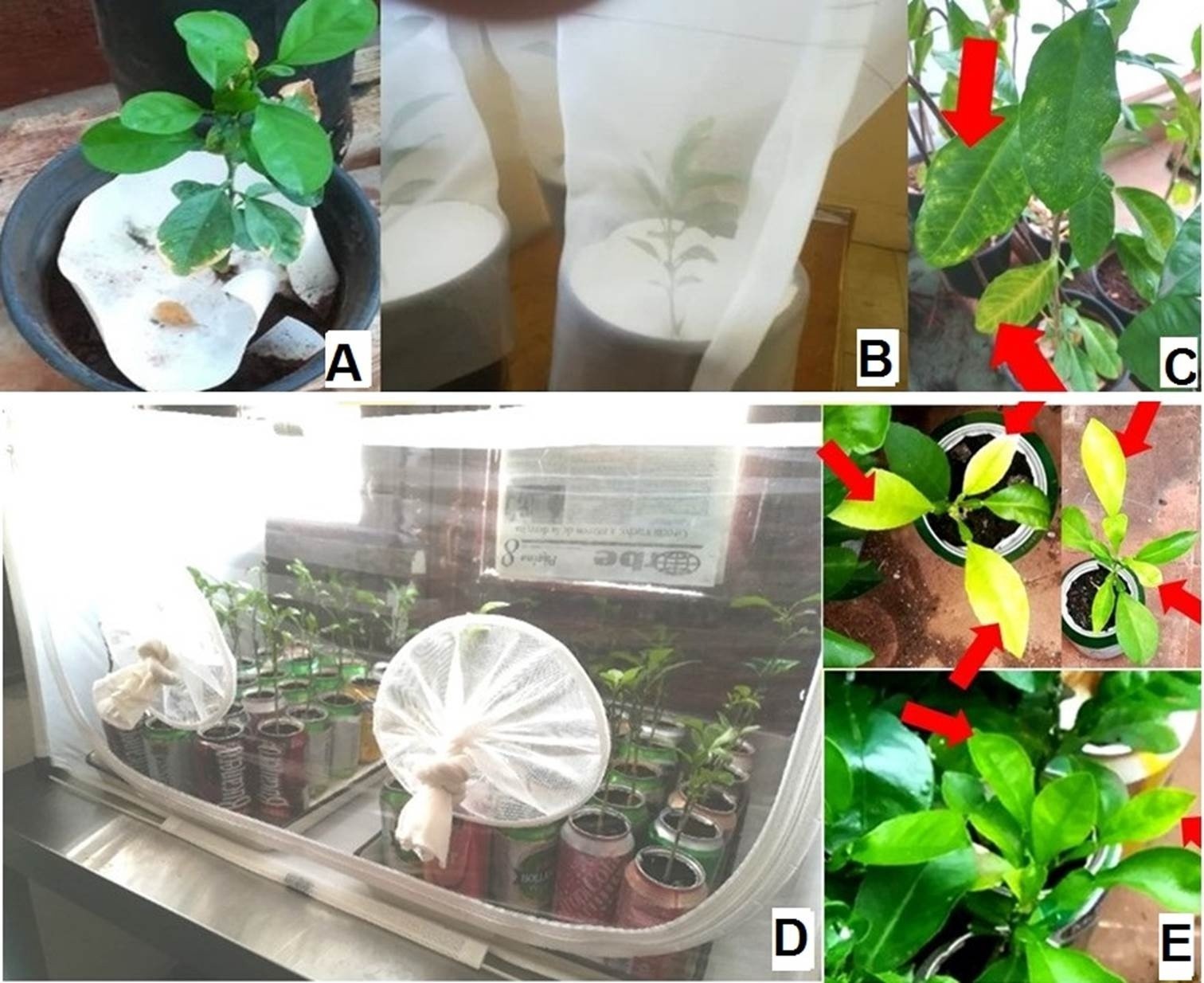
“Huanglongbing” (HLB) or citrus greening, associated with three ‘Candidatus Liberibacter’ species, is the most serious disease threating the citrus industry worldwide. Up to date, ‘Ca. L. asiaticus’ is the only species reported in Cuba associated with HLB and its insect vector Diaphorina citri Kuwayama. The ability of D. citri to transmit the bacterium under the Cuban environmental conditions has been assumed for years, but never experimentally proven. In two trials of HLB transmission to healthy citrus plants using D. citri, 33 out from the 45 inoculated plants showed symptoms of the disease 6 months after inoculation, and 20 out from of the 23 insect pools used tested PCR positive for ‘Ca. L. asiaticus’. The sequences of four amplicons from the 16S gene were obtained. They showed 100% identity among them and with a number of sequences of ‘Ca. L. asiaticus’ strains; therefore, one sequence per host species was submitted to GenBank. A comprehensive survey on comparable partial sequences deposited in GenBank allowed detecting nine 16Sr SNP lineages determined by the presence of 15 SNPs in at least two sequences when compared with ‘Ca. L. asiaticus’ strain Las_36 (GenBank accession number MK142763) as reference. The sequences from the transmission trials, together with other 27 sequences, did not show SNPs supporting the presence in Cuba of a bacterial strain with a low genetic variability. This is the first report on experimental transmission of ‘Ca. L. asiaticus’ to citrus by D. citri in Cuba.
Article Details

This work is licensed under a Creative Commons Attribution-NonCommercial 4.0 International License.
Aquellos autores/as que tengan publicaciones con esta revista, aceptan los términos siguientes:
- Los autores/as conservarán sus derechos de autor y garantizarán a la revista el derecho de primera publicación de su obra, el cual estará simultáneamente sujeto a la Licencia Creative Commons Attribution-NonCommercial 4.0 International (CC BY-NC 4.0) que permite a terceros compartir la obra, siempre que se indique su autor y la primera publicación en esta revista. Bajo esta licencia el autor será libre de:
- Compartir — copiar y redistribuir el material en cualquier medio o formato
- Adaptar — remezclar, transformar y crear a partir del material
- El licenciador no puede revocar estas libertades mientras cumpla con los términos de la licencia
Bajo las siguientes condiciones:
- Reconocimiento — Debe reconocer adecuadamente la autoría, proporcionar un enlace a la licencia e indicar si se han realizado cambios. Puede hacerlo de cualquier manera razonable, pero no de una manera que sugiera que tiene el apoyo del licenciador o lo recibe por el uso que hace.
- NoComercial — No puede utilizar el material para una finalidad comercial.
- No hay restricciones adicionales — No puede aplicar términos legales o medidas tecnológicas que legalmente restrinjan realizar aquello que la licencia permite.
- Los autores/as podrán adoptar otros acuerdos de licencia no exclusiva de distribución de la versión de la obra publicada (p. ej.: depositarla en un archivo telemático institucional o publicarla en un volumen monográfico) siempre que se indique la publicación inicial en esta revista.
- Se permite y recomienda a los autores/as difundir su obra a través de Internet (p. ej.: en archivos telemáticos institucionales o en su página web) antes y durante el proceso de envío, lo cual puede producir intercambios interesantes y aumentar las citas de la obra publicada. (Véase El efecto del acceso abierto).
References
Bové J-M. “Huanglongbing” or yellow shoot, a disease of Gondwanan origin: will it destroy citrus worldwide? Phytoparasitica. 2014; 42:579-583. https://doi.org/ 10.1007/s12600-014-0415-4
Da Graça JV, Douhan GW, Halbert SE, Keremane ML, Lee RF, Vidalakis G, Zhao, H. “Huanglongbing”: an overview of a complex pathosystem ravaging the world’s citrus. Journal of Integrative P lant Biology. 2016;58(4):373-387. https://doi.org/ 10.1111/jipb.12437
Luis M, Collazo C, Llauger R, Blanco E, Peña I, López D, et al. Occurrence of citrus “huanglongbing” in Cuba and association of the disease with ‘Candidatus Liberibacter asiaticus’. Journal Plant Pathology. 2009;91(3):709-712.
Luis-Pantoja M, Paredes-Tomás C, Uneau Y, Myrie W, Morillon R, Satta E, et al. Identification of ‘Candidatus Phytoplasma’ species in “huanglongbing” infected citrus orchards in the Caribbean. Eur.
J. Plant Pathol. 2021; 160:185-198. https://doi.org/ 10.1007/s10658-021-02234-7
Albrecht U, Hall DG, Bowman K.D. Transmission efficiency of ‘Candidatus Liberibacter asiaticus’ and progression of “huanglongbing” disease in graft- and psyllid-inoculated citrus. HortScience. 2014; 49(3):367-377.
Ammar ED, Hall DG, Hosseinzadeh S, Heck
M. The quest for a non-vector psyllid: Natural variation in acquisition and transmission of the “huanglongbing” pathogen ‘Candidatus Liberibacter asiaticus’ by Asian citrus psyllid isofemale lines. PloS One. 2018;13(4): e0195804. https://doi.org/ 10.1371/journal.pone.0195804
Ammar ED, George J, Sturgeon K, Stelinski LL, Shatters RG. Asian citrus psyllid adults inoculate “huanglongbing” bacterium more efficiently than nymphs when this bacterium is acquired by early instar nymphs. Scientific Reports. 2020; 10:18244. https:// doi.org/10.1038/s41598-020-75249-5
Capoor SP, Rao DG, Viswanath S. Diaphorina citri Kuway., a vector of the greening disease of citrus in India. Indian Journal Agricultural Sciences. 1967; 37:572-579.
Canale MC, Tomaseto AF, Haddad ML, Coletta- Filho, HD, Lopes JRS. Latency and persistence of ‘Candidatus Liberibacter asiaticus’ in its psyllid vector, Diaphorina citri (Hemiptera: Lividae). Phytopathology. 2017; 107:264-272. https://doi.org/ 10.1094/PHYTO-02-16-0088-R
Lopes SA, Frare GF, Bertolini E, Cambra M, Fernandes NG, Ayres AJ, et al. Liberibacters associated with citrus “huanglongbing” in Brazil: ‘Candidatus Liberibacter asiaticus’ is heat tolerant, ‘Ca. L. americanus’ is heat sensitive. Plant Disease. 2009; 93:257-262. https://doi.org/10.1094/PDIS-93-3-0257
Lopes SA, Luiz FQBF, Martins EC, Fassini CG, Sousa MC, Barbosa JC, et al. ‘Candidatus Liberibacter asiaticus’ titers in citrus and acquisitions rates by Diaphorina citri are decreased by higher temperatures. Plant Disease. 2013; 97:1563-1570. https://doi.org/ 10.1094/PDIS-11-12-1031-RE
Lopes SA, Luiz FQBF, Oliveira HT, Cifuentes- Arenas JC, Raiol-Junior LL. Seasonal variation of ‘Candidatus Liberibacter asiaticus’ titers in new shoots of citrus in distinct environments. Plant Disease. 2017; 101:583-590. https://doi.org/ 10.1094/PDIS-06-16-0859-RE
Bosco D, Tedeschi R. Insect vector transmission assays. In: Dickinson M, Hodgetts J, editors. Phytoplasma: Methods and protocols (Internet). Totowa, N.Y.: Humana Press; 2012. https:// doi.org/10.1007/978-1-62703-089-2
Paredes-Tomás C, Luis-Pantoja M, Rodríguez- Tapia JL, Bertaccini A. Haplaxius crudus transmission of 'Candidatus Phytoplasma palmae' to coconut seedlings in Cuba. Phytopathogenic Mollicutes. 2023; 13(2): 177-182. https:// doi.org/10.5958/2249-4677.2023.00078.6
Murray MG, Thompson WF. Rapid isolation of high molecular weight plant DNA. Nucleic Acid Research. 1980; 8(19):4321-4325.
Weisburg WG, Barns SM, Pelletier DA, Lane DJ. 16S ribosomal DNA amplification for phylogenetic study. Journal of Bacteriology. 1991; 173:697-703.
Jagoueix S, Bové J-M, Garnier M. PCR detection of the two ‘Candidatus’ liberobacter species associated with greening disease of citrus. Molecular and Cellular Probes 1996; 10:43-50.
Nelson WR. Reported single nucleotide polimorphisms on the 16S rRNA gene do not support haplotypes of ‘Candidatus Liberibacter asiaticus’. Citrus Research Technology. 2012;33(2):75-79. https://doi.org/10.5935/2236-3122.20120009
A simple method for estimating evolutionary rates of base substitutions through comparative studies of nucleotide sequences. J. Mol. Evol. 1980; 16:111-120.
Kumar S, Stecher G. Tamura K.. MEGA7: molecular evolutionary genetics analysis version 7.0 for bigger datasets. Mol. Biol. Evol. 2016; 33(7):1870-1874. https://doi.org/10.1093/molbev/msw054
Johannesen J, Foissac X, Kehrli P, Maixner M. Impact of vector dispersal and host-plant fidelity on the dissemination of an emerging plant pathogen. PLoS ONE. 2012; 7(12): e51809. https://doi.org/ 10.1371/journal.pone.0051809
González C, Hernández D, Cabrera RI, Tapia JR. Diaphorina citri Kuw., inventario y comportamiento de los enemigos naturales en la citricultura cubana. FAO Plant Protection Bulletin. 2007: 3-9.
Bové J-M. Huanglongbing: a destructive, newly- emerging, century-old disease of citrus. Journal Plant Pathology. 2006; 88(1):7−37.
De-Souza IP, Galdeano, DM, Lopes JRS, Machado MA. Development on infected citrus over generations increases vector infection by 'Candidatus Liberibacter asiaticus’ in Diaphorina citri. Insects. 2020; 11(8):469. https://doi.org/10.3390/insects11080469
Lopes SA, Cifuentes-Arenas JC. Protocol for successful transmission of ‘Candidatus Liberibacter asiaticus’ from citrus to citrus using Diaphorina citri. Phytopathology. 2021;111(12):2367-2374. https:// doi.org/10.1094/PHYTO-02-210076-R
Inoue H, Ohnishi I, Ito T, Tomimura K, Miyata S, Iwanami T, Ashihara, W. Enhanced proliferation and efficient transmission of ‘Candidatus Liberibacter asiaticus’ by adult Diaphorina citri after adquisition feeding in the nymphal stage. Annals of Applied Biology. 2009; 155:29-36. https://doi.org/ 10.1111/j.1744-7348.2009.00317.x
Adkar-Purushothama CR, Quaglino F, Casati P, Gottravalli Ramanayaka J, Bianco, PA. Genetic diversity among ‘Candidatus Liberibacter asiaticus’ isolates based on single nucleotide polymorphisms in 16S rRNA and ribosomal protein genes. Annals of Microbiology. 2009; 59(4):681-688. https://doi.org/ 10.1007/bf03179208
Paredes-Tomás C, Luis-Pantoja M, Ramos-Leal M and Bertaccini A. 2024. Obtaining positive controls for the detection of two polymorphic regions in Cuban strains of 'Candidatus Liberibacter asiaticus'. Rev. Protección Veg. 2024: 39: 1-5. Cu-ID: 2247/v39e09.