Effect of propolis on control of diseases and postharvest quality of Psidium guajava L.
Article Sidebar
Main Article Content
Abstract
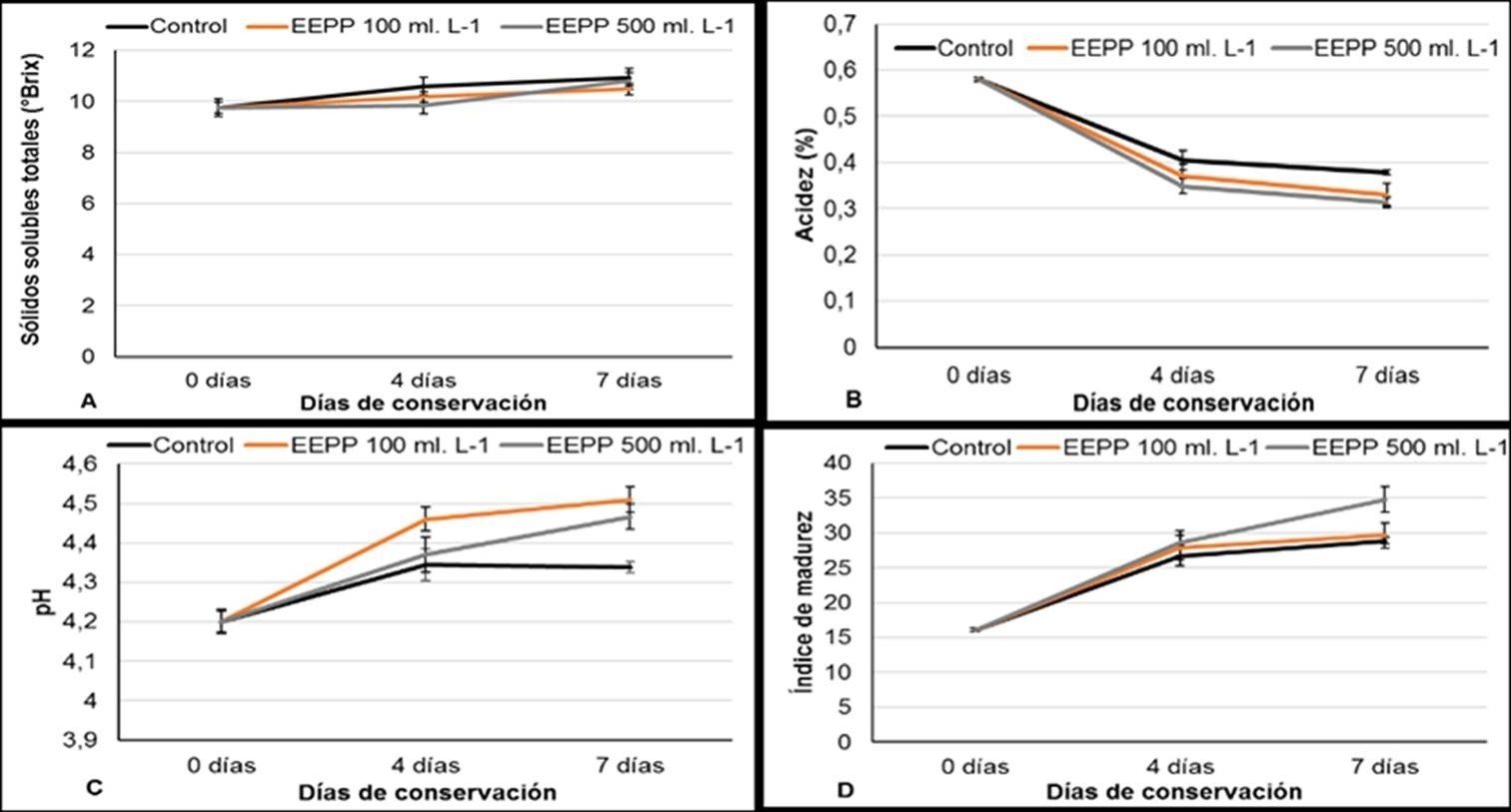
The objective of this work was to evaluate the effect of the ethanolic extract of brown propolis (7%) (EEPP), a product with antifungal and biofilm-forming properties, on the control of postharvest diseases and quality indicators of cv. ʻEnana Roja Cubanaʼ guavas (Psidium guajava L.). Two concentrations of EEPP, 100 and 500 ml.L-1, along with two controls were used to evaluate the in vitro effect of this product on growth of the fungi Phomopsis psidii De Camara, Guignardia psidii Ullasa & Rawal and Colletotrichum spp. and control of the diseases caused by these pathogens by submerging the fruits in the product for 5 min. After seven days of guavas being stored at 18°C ± 2°C, damage incidence (%) and severity (%) were determined. At the beginning, with four and seven days of storage, the fruits were also examined for fresh mass losses (%), exocarp color (L, a* and b*), mesocarp firmness (kgf), total soluble solids (ºBrix), titratable acidity (%), pH, and maturity index (MI). EEPP showed differentiated antifungal activity; with a higher percentage of growth inhibition in Colletotrichum spp. at both concentrations, it was greater at 500 ml. L-1 in P. psidii and G. psidii showed lower values. Fruits treated with EEPP at 500 ml.L-1 showed lower incidence and severity of damage by anthracnose and style rot. Furthermore, they presented lower losses of fresh mass and did not reveal changes in their physical and chemical parameters. Greater effects by Phyllosticta rot were observed in the guava fruits with EEPP at both concentrations.
Article Details

This work is licensed under a Creative Commons Attribution-NonCommercial 4.0 International License.
Aquellos autores/as que tengan publicaciones con esta revista, aceptan los términos siguientes:
- Los autores/as conservarán sus derechos de autor y garantizarán a la revista el derecho de primera publicación de su obra, el cual estará simultáneamente sujeto a la Licencia Creative Commons Attribution-NonCommercial 4.0 International (CC BY-NC 4.0) que permite a terceros compartir la obra, siempre que se indique su autor y la primera publicación en esta revista. Bajo esta licencia el autor será libre de:
- Compartir — copiar y redistribuir el material en cualquier medio o formato
- Adaptar — remezclar, transformar y crear a partir del material
- El licenciador no puede revocar estas libertades mientras cumpla con los términos de la licencia
Bajo las siguientes condiciones:
- Reconocimiento — Debe reconocer adecuadamente la autoría, proporcionar un enlace a la licencia e indicar si se han realizado cambios. Puede hacerlo de cualquier manera razonable, pero no de una manera que sugiera que tiene el apoyo del licenciador o lo recibe por el uso que hace.
- NoComercial — No puede utilizar el material para una finalidad comercial.
- No hay restricciones adicionales — No puede aplicar términos legales o medidas tecnológicas que legalmente restrinjan realizar aquello que la licencia permite.
- Los autores/as podrán adoptar otros acuerdos de licencia no exclusiva de distribución de la versión de la obra publicada (p. ej.: depositarla en un archivo telemático institucional o publicarla en un volumen monográfico) siempre que se indique la publicación inicial en esta revista.
- Se permite y recomienda a los autores/as difundir su obra a través de Internet (p. ej.: en archivos telemáticos institucionales o en su página web) antes y durante el proceso de envío, lo cual puede producir intercambios interesantes y aumentar las citas de la obra publicada. (Véase El efecto del acceso abierto).
References
Mulkay T. Poscosecha. En: Editorial Instituto de Investigaciones en Fruticultura Tropical. Cultivo y Comercialización de la Guayaba. La Habana, Cuba. 2023. 253 pp.
Valdés Infante J, Betancourt M, Mulkay T, Abreu S, Rodríguez Y, Guevara G, et al. En: Editorial Instituto de Investigaciones en Fruticultura Tropical. La cadena de valor de la guayaba, su situación en cinco municipios de las provincias de Artemisa y Santiago de Cuba. La Habana, Cuba. 2022.165 pp.
Instituto de Investigaciones en Fruticultura Tropical (IIFT). Instructivo técnico para el cultivo de la guayaba. Editorial Instituto de Investigaciones en Fruticultura Tropical. 2023. 105 pp.
Retamoso R, Ruiz G, Benítez, M. Efecto antifúngico de extractos de propóleos obtenidos en la provincia de Jujuy, Argentina. Revista Científica de la Facultad de Ciencias Agraria. 2021; 14 (1): 69-76.
Cui J, Duan X, Ke L, Pan X, Liu J, Song X, et al. Extraction, purification, structural character and biological properties of propolis flavonoids: a review. Fitoterapia. 2021; 157:105106. http:// dx.doi.org/10.1016/j.fitote.2021.105106
Rech C, Gil de Oliveira H, San Martins L, Pansera M R, Silvestre W P, Siqueira G R, et al. Evaluation of the antifungal activity of propolis extracts from stingless bees on phytopathogenic fungi. Research, Society and Development. 2022; 11(16):1-9. http:// dx.doi.org/10.33448/rsd-v11i16.38445
Urrea I, Arismendi N, Sepúlveda X, Gerding M, Vero S, Vargas M. Antifungal activity of propolis extracts against postharvest pathogen Phlyctema vagabunda. Rev. Agronomy. 2023;104 (13): 2-14. http://doi.org/ 10.3390/agronomy13010104
Osís A. Efecto de recubrimiento natural de propóleo de abeja en la pérdida de peso, color, firmeza y análisis microbiológico de la palta. Revista Facultad de Ingeniería José María Guarderas. 2020; 2(7):14-20. https://repositorio.unajma.edu.pe/ bitstream/handle/UNAJMA/604/
Pobiega K, Kraśniewska K, Gniewosz M. Application of propolis in antimicrobial and antioxidative protection of food quality. A review. Trends in Food Science and Technology. 2019; 83:53-62. http:// doi.org/10.1016/j.tifs.2018.11.007
Padrón A, Naranjo A, Díaz J, Llera R. El propóleo una alternativa de todos los tiempos; 2019. Disponible en: http://www.researchgate.net/publication/330289548. Acceso: 2023- 11- 20.
Rodríguez IC, Flores J. Capacidad antagónica in vitro de Trichoderma spp. frente a Rhizoctonia solani K. y Fusarium verticillioides N. Bioagro. 2018; 30(1):49-58.
Snowdon AI. Post-harvest diseases and disorders of fruits and vegetables. General introduction and fruits. University of Cambridge. Wolf Scientific Lid. 1990; 1: 302 pp.
McKinney HH, Davis RJ. Influence of soil temperature and moisture on infection of wheat seedlings by Helmintosporium sativum. J. Agric. Res. 1923; 31(9):827-840.
Machado-Molina M, García-Pereira A, Machado- García N. Propuesta de rangos de índice de color según estados de maduración en frutas. Revista Ciencias Técnicas Agropecuarias. 2019; 28(4):19-27. Disponible en: http://opn.to/a/RYhSJ. Acceso: 2024- 10- 4.
Dudoit A, Cardinault N, Mertz C, Chillet M, Brat P. Antifungal activities of propolis and its main components with an emphasis against phytopathogenic fungi. J. APIC. SCI. 2021; 65(1):5-24. http://doi.org/ 10.2478/JAS-2021-0013
Cupull R, Cortés R, Olazábal E, Hernández C. Actividad antifúngica de propóleos obtenidos en tres provincias de Cuba sobre hongos contaminantes en cultivo de tejidos vegetales. Universidad de Guanajato. Acta Universitaria. 2013; 23(6):3-9.
Pereira L, Pereira de Menezes A C, Frederico de Souza C, Abadia M. Efeito fungicida agrícola do extrato de própolis de Tetragonisca angustula Latreille, 1811. Brazilian Journal of Science. 2023; 2(11):65-7. http://doi.org/10.14295/bjs.v2i11.411
Quiroga EN, Sampeiro DA, Soberón JR, Sgariglia MA, Vattuone MA. Propolis from the northwest of Argentina as a source of antifungal principles. Journal of Applied Microbiology. 2006; 101: 103-110. http://doi.org/10.1111/j.1365-2672.2006.02904.x
Manzo-Sánchez G, Pérez-Ocón P, Chan-Cupul W, Silva-Jiménez E, Sánchez-Rangel J C, Ayala-Zermeño M A, et al. Actividad antifúngica de extractos etanólicos de propóleos contra Mycosphaerella fijiensis: un estudio in vitro. Scientia Fungorum. 2018; 47: 13-24.
Peng L, Yang S, Chen Y, Chen F. Antifungal activity and action mode of pinocembrin from propolis against Penicillium italicum. Food Science and Biotechnology. 2012; 21(6):133-1534. http://doi.org/10.1007/s10068-012-0204-0
El-Gawad M. Influence of propolis extract and oxalic acid on preserving quality of guava fruits during postharvest cold storage. Plant Archives. 2021; 21, Supplement 1: 127-138. http://doi.org/10.51470/PLANTAARCHIVE.2021.v21.S1.024
Loebler M, Sánchez C, Muchagato E, Diogo E, Santos M, Vasilenko P, et.al. Potential application of propolis extracts to control the growth of Stemphylium vesicarium in “Rocha” pear. Appl. Sci. 2020; 10: 1990. http://doi.org/10.3390/app10061990
Daiuto E, Minarelli P, Vieites R, Orsi R. Própolis e cera vegetal na conservação de abacate Hass. Semina: Ciências Agrárias. 2012; 33 (4):1463-1474. http://doi.org/10.5433/1679-0359.2012v33n4p1463
Montes A, Oropeza R, Padrón C. Películas biodegradable con propiedades activas. Revista Venezolana de Ciencia y Tecnología. 2017; 8(1): 58-89. Disponible en: https://sites.google.com/site/1rvcta Acceso: 2024- 10- 4.
Aguilar J, García I, Quiróz J. Alargamiento de la vida anaquel de las frutas por el uso de biopelículas. Revista Boliviana de Química. 2020; 31(1): 40-45. http://doi.org/10.34098/2078-3949.37.1.6
Mulkay T, Suárez M, Paumier A. Indicadores de calidad de la guayaba ‘Enana Roja Cubana E.E.A 18-40’ durante la conservación poscosecha. Centro Agrícola. 2020; 47(4):73-80.
Botia L, Koop E. Comparación de las propiedades colorimétricas en guayaba con aplicación de recubrimientos. Revista UPTCV. 2018;12-27. Disponible en: https://rdigitales.uptc.edu.co/memorias/index.php/8_enc_cien/8_fac_cien/paper/view/2095. Acceso: 2024- 10- 4.
Arrieta A, Baquero U, Barrera J. Caracterización fisicoquímica del proceso de maduración del plátano “Papocho” (Musa ABB Simmonds). Revista Agronomía Colombiana. 2006; 24(1): 48-53. http://revista.unal.edu.co/index.php/agrocol/
Gutiérrez N, Dussan S, Castro J. Fisiología y atributos de la calidad de la guayaba ʻPeraʼ (Psidium guajava L.) en poscosecha. Rev. Ing. 2012; (37):6-12. Disponible en http://www.redalyc.org/articulo.oa?id=121026469008 Acceso: 2024- 09- 13.
Miranda A, Alvis A. Arrazola G. Efectos de dos recubrimientos sobre la calidad de la papaya (Carica papaya) variedad Tainung. Temas Agrarios. 2014;19(1):7- 18.
Aquino A A de, Rodríguez R da S, Donato I A, Brandão M R S, Moreira E de S, Costa M L X, et.al. Revestimento à base de amido extraído da semente de Manga Palmer com adição de extrato de própolis na conservação de Abacate Geada. Brazilian Journal of Development. 2020; 6 (9):71116-71135. http://doi.org/10.34117/bjdv6n9-526
Awad M, Al-qurashi A. Quality and biochemical changes of ‛Sukkari’ Bananas during shelf life as affected by postharvest dipping in Ethanolic Extract of Propolis. Philippine Agricultural Scientist. 2019; 102(2): 132-140. Disponible en http://pas.cafs.uplb.edu.ph/download/quality- and-biochemical-changes-of-sukkari-bananas-during-shelf-life-as-affected-by-posharvest-dipping-in- ethanolic-extract-of-propolis/ Acceso: 2024- 02- 11.